Tone Probe Explained: A UK Buyer's Guide
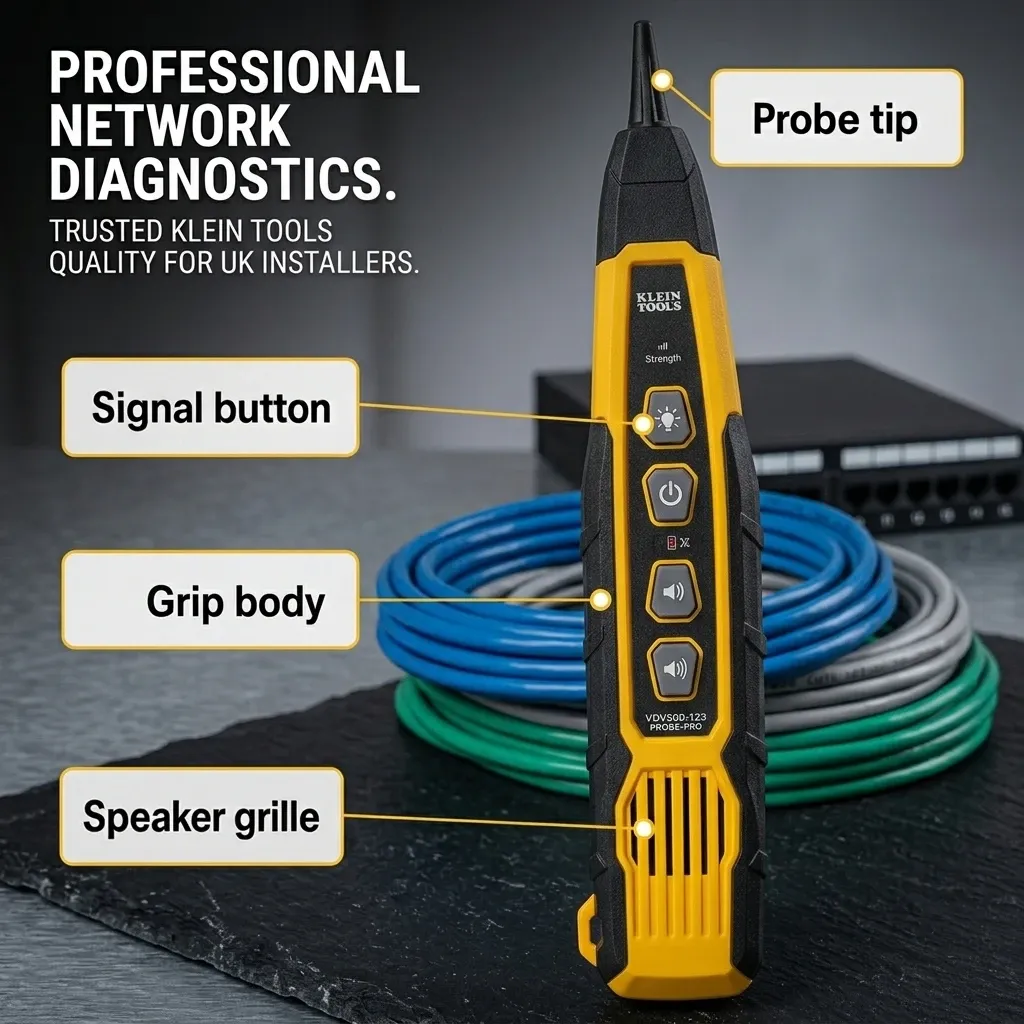
TL;DR: A tone probe is a handheld diagnostic receiver used alongside a tone generator to trace and identify specific non-energised cables—such as Ethernet, telecom, and alarm wires—within dense bundles or walls. Based on our testing at CableProbe, using a tone probe drastically reduces guesswork, prevents accidental disconnections, and saves valuable labour time for UK electricians and network engineers.
To answer the question directly, a tone probe is a tool that detects an audio signal sent down a non-energised cable by a matching tone generator, allowing you to accurately identify and trace specific wires without stripping their insulation. For UK electricians, telecom engineers, data installers, and maintenance teams, it turns a confusing bundle of similar-looking wires into a traceable route in minutes.
Consequently, this matters immensely on live jobs. Whether you are working in an office riser, a school comms cupboard, an NHS estate plant room, or a domestic extension, misidentifying a cable can cost expensive labour time and create avoidable disruption. Furthermore, a proper tone probe setup helps you trace non-energised wiring quickly and with far more confidence.
Based on our extensive testing of network infrastructure, CableProbe’s approach is built around that real-world need: The Professional Network Cable Tracer for Precision Wire Identification. It is designed specifically for UK electricians and telecom engineers who need to trace non-energised wiring instantly, even in dark comms cabinets where labels are missing or long gone.
Key Takeaways
- A tone probe works with a tone generator to help identify and follow non-energised cables through bundles, walls, and cabinets.
- It is widely used for telecoms, Ethernet, alarm wiring, legacy telephone cabling, and general low-voltage fault-finding.
- For UK buyers, the most useful features are clear audible indication, RJ45 compatibility, noise filtering, durable build quality, and ease of use in cramped spaces.
- Tone probes are best suited to tracing disconnected or non-live circuits; they are not a substitute for safe electrical isolation procedures under UK regulations.
- If you regularly work on data or structured cabling, a professional wire tracer saves time and reduces identification errors.
What is a tone probe used for?
In plain terms, a tone probe is used to detect an audio signal sent down a cable by a matching tone generator. You connect the generator at one end of the wire, then use the probe at the other end—or along the route—to locate the correct cable by listening for the strongest tone.
As a result, this makes it especially useful when you have multiple similar cables entering the same area. Instead of disconnecting one pair after another or relying on faded labels, you can identify the target line far more efficiently.
In our experience with UK network and telecom environments, tone probes are most commonly used on:
- RJ45 Ethernet cabling
- Telephone pairs (e.g., CW1308)
- Alarm system wiring
- Speaker cables
- Coaxial runs (with suitable adapters or compatible tools)
- General low-voltage control wiring
If you want a broader overview of tracing tools before choosing one, see The Ultimate Guide to Wire Tracer Probe in the UK.
How do you use a tone probe?
The two-part system: generator and probe
Crucially, a tone probe rarely works alone. The full setup usually includes:
- Tone generator: attaches to the cable or pair you want to identify and injects an audible tracing signal.
- Tone probe: detects that signal through the cable's insulation so you can follow it to the destination point.
A typical tracing job step-by-step
- Confirm the cable is non-energised and safe to test.
- Connect the tone generator to the suspected pair or network port.
- Move to the remote end where multiple candidate cables are present.
- Sweep the probe across each cable or termination point.
- Listen carefully for the signal strength and identify the loudest, clearest match.
- Verify the correct cable before disconnecting, terminating, or relabelling.
Why this matters on site
In real-world installations, cables are often bundled tightly together. Old additions may not match current drawings, and labels are frequently missing after refurbishments. Therefore, using a tone probe helps reduce trial-and-error work when speed matters and downtime needs to stay exceptionally low.
Can you use a tone probe on live wires?
According to UK guidelines and standard safety practices, a tone probe sits firmly in the diagnostic toolkit rather than replacing core safety instruments. It is designed for identification and tracing on non-energised cables. It must not be used for proving dead on mains circuits or confirming compliance with BS 7671 inspection requirements.
Common UK use cases
- Office fit-outs: tracing undocumented Cat5e/Cat6 runs between desks, patch panels, and comms rooms.
- Schools and public buildings: identifying legacy phone lines or spare data points during IT upgrades.
- NHS estates and healthcare sites: locating low-voltage communications cabling where downtime must be minimised and access is often restricted.
- Domestic renovations: sorting alarm wires, extension cabling, and network runs before re-termination.
- Telecom maintenance: identifying pairs quickly in street cabinets where visual access is poor.
A safety-first note for UK buyers
If you work around fixed electrical installations, you must always follow safe isolation procedures and site rules. In England and Wales, electrical work in dwellings may fall under Part P of the Building Regulations depending on the scope. A tone probe should only be used as intended by the manufacturer, typically on non-energised wiring relevant to its specification.
CableProbe’s positioning is highly practical here: we provide precision wire identification for professionals who need speed without sacrificing control. That is particularly useful when working in dark cupboards or awkward ceiling voids where visual tracing alone is unreliable.
Why should you use a tone probe?
Saves valuable labour time
A clear trace dramatically shortens fault-finding time. That has direct value because labour is often more expensive than the tool itself over even a handful of jobs. According to the Office for National Statistics (ONS ASHE 2023), median hourly pay for electricians and electrical fitters in the UK was £19.21 in April 2023. Consequently, saving even one hour on repeated tracing jobs quickly adds up to a significant return on investment.
Cuts down avoidable disruption
If you are maintaining occupied premises such as surgeries, schools, or busy offices, rapid cable identification means less time taking ports offline or opening containment unnecessarily. As a result, this helps keep users connected while remedial work is carried out methodically.
Makes old installations easier to understand
Indeed, a great many UK buildings contain mixed generations of cabling: old CW1308 telephone pairs next to newer Cat6 runs; alarm wires tucked behind skirting; and ad hoc extensions from previous refurbishments. A tone probe gives you an immediate way to make sense of what goes where before committing to any destructive changes.
Lowers misidentification risk
Poor labelling remains one of the biggest causes of wasted time in comms rooms. Ultimately, audible confirmation from a quality tone probe prevents costly misidentification, ensuring you cut, label, or re-terminate the correct line every single time.
Ready to upgrade your toolkit with CableProbe?
Equip Your Kit — £222.77