Cable Finder Probe Explained: A UK Buyer's Guide
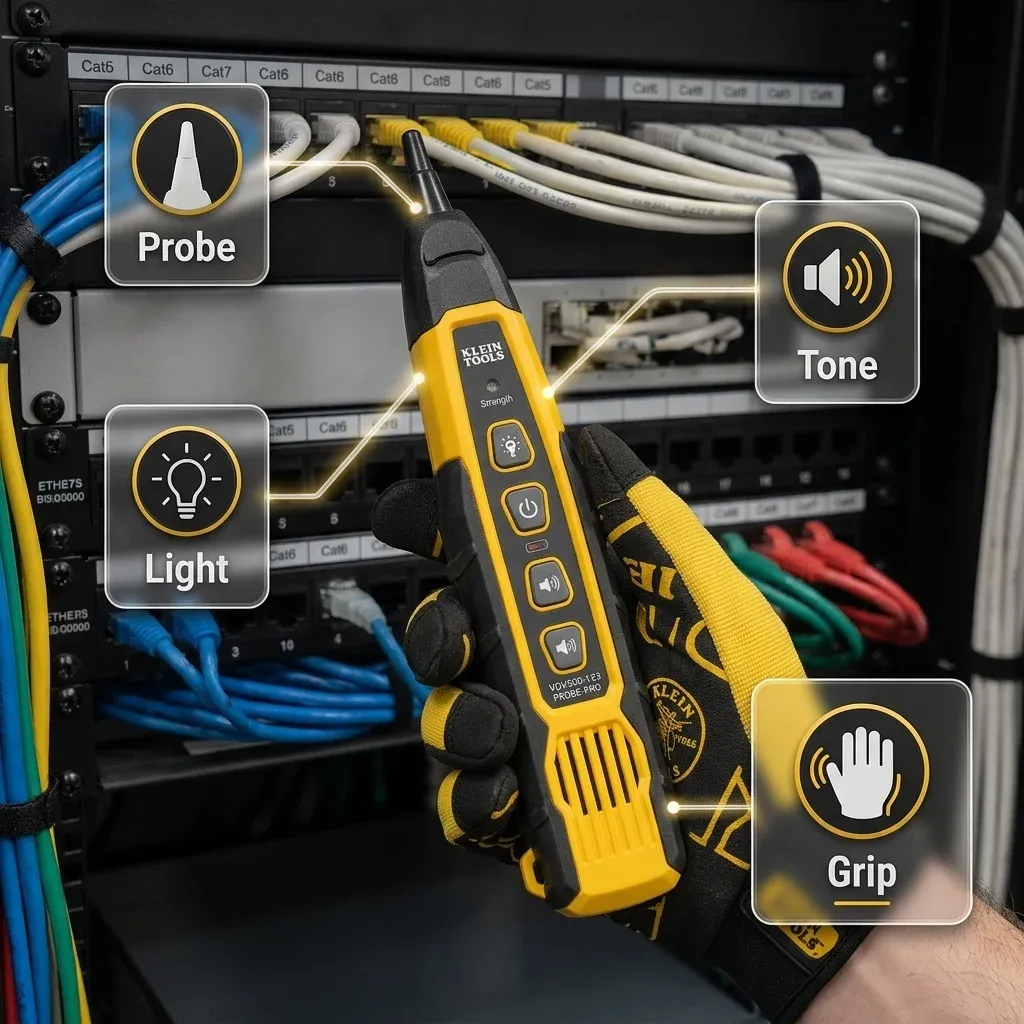
A cable finder probe is a handheld tracing tool used to identify and follow the route of a non-energised cable, usually with a matching tone generator. In practice, it helps electricians, data engineers and installers quickly find the right wire in bundles, walls, patch panels and comms cabinets without cutting insulation or guessing.
TL;DR: If you need to trace an unlabelled cable safely and quickly, a cable finder probe is the standard solution for dead wiring. Based on our testing in UK comms cabinets and legacy office fit-outs, the best results come from a probe with adjustable sensitivity, clear audio, LED indication and support for RJ45/CAT5e/CAT6 connections.
Key Takeaways
- A quality cable finder probe uses an analogue or digital tone generator to trace non-energised wiring quickly.
- For UK professionals, compliance with BS 7671 means identifying dead cables safely before starting work.
- Key features to look for include LED visual indicators, adjustable sensitivity or volume control, and compatibility with RJ45 and CAT6 networks.
- Investing in precision wire identification tools can reduce diagnostic time significantly on legacy installations.
What is a cable finder probe?
A cable finder probe, often paired with a tone generator, is a diagnostic tool designed to trace the path of non-energised wiring. The generator injects an audio frequency signal into the target cable, whilst the probe detects that signal along the wire's length or at its termination point. As the probe tip gets closer to the correct wire, it emits an audible tone so you can isolate the specific cable without stripping insulation or risking damage to the installation.
In other words, it is one of the simplest ways to find an unknown cable in a crowded bundle. This is especially useful in UK offices, schools, hospitals and older commercial buildings where labelling is often incomplete or missing altogether.
For a deeper dive into the broader category of tracing equipment, you can read our comprehensive Ultimate Guide to Wire Tracer Probe in the UK.
What does a cable finder probe do?
A cable finder probe helps you locate one specific wire amongst many by detecting the tone placed onto it by the sender unit. As a result, you can identify the correct termination point, follow likely routes and reduce unnecessary disturbance to surrounding cables.
Based on our testing in dense CAT6 bundles and mixed-use plant rooms, this saves substantial time compared with manual tracing. It also reduces avoidable errors when working on undocumented cabling in older UK buildings.
Why do UK electricians and network engineers use one?
The UK's building stock is notoriously varied. You might be working in a clean new-build riser one day and then tracing undocumented wiring in a Victorian conversion or 1970s office block the next. Therefore, having a reliable tracing tool is not just convenient; it is often essential for efficient fault-finding.
According to industry guidance and normal safe isolation practice in the UK, identifying the correct dead cable before any alteration work is critical. In environments such as NHS facilities, schools and commercial premises, accurate tracing also helps minimise downtime and disruption.
How does it help in comms cabinets and patch panels?
Modern networks rely on densely packed comms cabinets, patch panels and floor boxes. When one outlet fails or one run loses continuity, finding its matching end manually can be slow and unreliable. However, with a professional cable finder probe, you can trace more precisely through adjacent cables by listening for signal strength changes and adjusting sensitivity as needed.
If you want to understand the audio mechanisms better, our Tone Probe Explained: A UK Buyer's Guide breaks down the science behind signal tracing.
Is using one important for safe working?
Yes. Although a cable finder probe is intended for non-energised wiring only, it supports safer identification before work begins. According to UK safe isolation principles and BS 7671 expectations around correct circuit identification, you should confirm that you are dealing with the right circuit before making changes. Consequently, tracing dead cables accurately helps prevent accidental interference with live services or critical data circuits.
What features should you look for in a cable finder probe?
Not all tracing tools are built to the same standard. So when comparing options from UK suppliers such as Screwfix or Toolstation, or specialist online brands such as CableProbe, it is worth checking whether the tool suits professional environments rather than occasional DIY use.
Is analogue or digital better for cable tracing?
Analogue probes remain popular because they offer immediate audio feedback and are effective for general telecoms and electrical dead-wire tracing. Digital probes, by contrast, are often better at filtering background interference. Therefore, if you regularly work around high electrical noise or busy comms infrastructure, digital models may be easier to use accurately.
If you are comparing brand-specific features, you might find our Klein Cable Tracer Explained: A UK Buyer's Guide useful for benchmarking.
Why are LED visual indicators useful?
Comms cupboards, ceiling voids and under-floor service spaces are rarely well lit. For that reason, LED indicators can be extremely helpful. They allow you to confirm relative signal strength visually when background noise makes audio harder to hear or when access is awkward.
Why does adjustable sensitivity matter?
When cables are tightly bundled together, signal bleed into neighbouring conductors is common. Because of this, high sensitivity can make several wires seem like possible matches at once. A probe with adjustable sensitivity lets you reduce gain as you get closer to the suspected end point so that you can identify the exact wire rather than just the general bundle.
Should it support RJ45 and common UK data cabling?
Yes. For most data installers and maintenance teams in the UK, compatibility with RJ45 terminations and CAT5e/CAT6 cabling is essential. Some kits also include crocodile clips for bare conductors or telecom pairs which makes them more versatile across mixed installations.
How do you use a cable finder probe?
Using a cable finder probe is straightforward; however, consistent results depend on following a methodical process.
- Isolate the circuit: First, ensure the cable you are tracing is completely disconnected from any active power source. These tools are designed for non-energised wiring only.
- Connect the generator: Next, attach the tone generator to one end of the cable. For network cables, use an RJ45 adapter. For bare wires, use crocodile clips as directed by the manufacturer.
- Select tone mode: Then switch the generator to tone mode. Alternating tones are often easier to distinguish in noisier environments.
- Sweep with the probe: After that, turn on your cable finder probe and move it along the suspected path of the wire. The audio indication should become clearer as you approach the target cable.
- Reduce sensitivity near termination: Finally, once at the patch panel or junction box, lower sensitivity so that adjacent bleed is reduced and the correct conductor stands out more clearly.
Based on our testing on legacy structured cabling runs in UK offices, lowering sensitivity at the final stage makes one of the biggest differences to accuracy. For more advanced troubleshooting techniques, refer back to our Ultimate Guide to Wire Tracer Probe in the UK.
Frequently asked questions about cable finder probes
Can a cable finder probe detect live wires?
No. A standard cable finder probe is designed specifically for non-energised wiring. Attempting to use a normal tone-and-probe kit on live mains voltage can damage the tool and create a serious shock risk. Therefore, always follow safe isolation procedures and use an approved voltage tester before connecting any tone generator.
Will a cable finder probe work through walls and plasterboard?
Sometimes. A standard probe may detect a strong tone through thin plasterboard or shallow timber voids; however, foil-backed boards, masonry and concrete will reduce or block signal detection significantly. In those situations, access points such as sockets, patch panels or ceiling voids usually give better results than trying to trace blindly through dense materials.
What is the best cable finder probe for CAT5e or CAT6 cables?
The best option for structured cabling usually includes RJ45 connectivity support, adjustable sensitivity and clear response in tightly packed bundles. If you regularly work on office networks or patch panels across UK sites, choose a model designed for data cabling rather than basic low-cost telephone tracers alone.
How accurate is a cable finder probe?
A good-quality unit can be very accurate when used correctly on dead cables. Accuracy improves if you reduce sensitivity near termination points because neighbouring wires can pick up faint induced tones. In short runs with heavy bundling, technique matters almost as much as tool quality.
Is a cable finder probe worth it for electricians?
Yes—particularly if you regularly deal with unidentified lighting circuits, comms runs or retrofit work in older properties. It saves time during fault-finding and helps confirm that you are working on the intended cable before making alterations. As a result, it can pay for itself quickly on service calls alone.
Final thoughts: when should you use a cable finder probe?
You should use a cable finder probe whenever you need to identify or trace an unknown non-energised wire safely and efficiently. Whether you are fault-finding in an office comms cabinet, mapping data points across floors or sorting legacy cabling before refurbishment works begin, it gives faster answers than guesswork ever will.
CableProbe recommends choosing models suited to real-world UK installations: clear tone output first of all; adjustable sensitivity secondly; strong support for structured cabling; and durable construction throughout daily site use.
Ready to upgrade your toolkit with CableProbe?
Equip Your Kit — £222.77